GitHub
GitHub is where the world builds software. What started as a Git repository hosting service in 2008 has become the central nervous system of modern software development—home to over 100 million developers, 420+ million repositories, and virtually every significant open source project on the planet. From a single developer's side project to the Linux kernel itself, GitHub is where code lives, breathes, and evolves.
Visit Website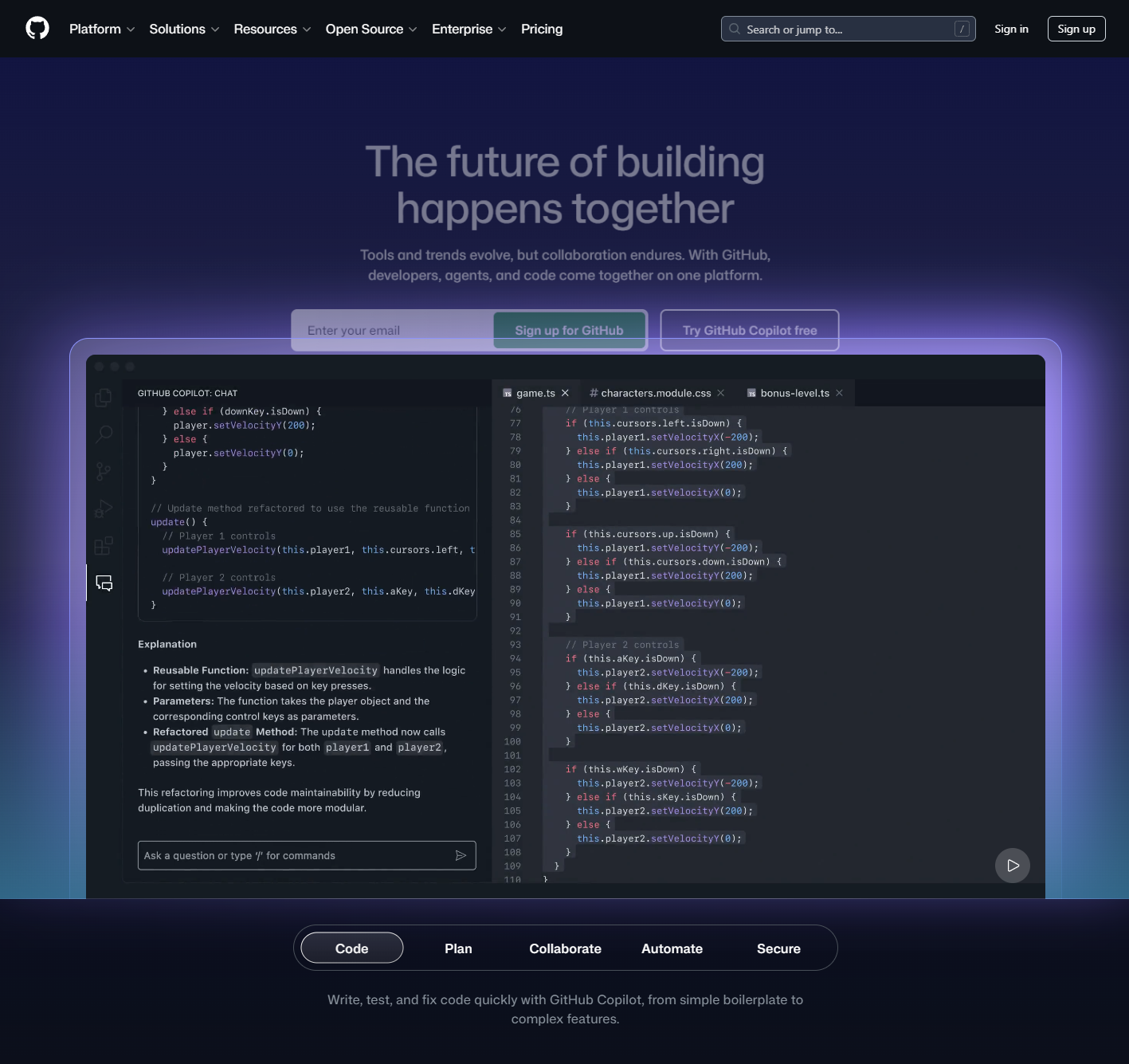
Why We Chose GitHub
GitHub represents something rare in technology: infrastructure so essential it becomes invisible. Developers don't think about GitHub—they just use it, the same way you don't think about electricity when you flip a switch. That level of ubiquity isn't achieved through marketing or luck. It's earned through relentless focus on developer experience, thoughtful design decisions, and a genuine understanding of how software gets built.
The platform's design philosophy reflects its audience. GitHub doesn't try to be flashy or trendy. It's clean, functional, and information-dense without feeling cluttered. Every pixel serves a purpose. The dark mode isn't an afterthought—it's a first-class experience because developers live in dark themes. The navigation is predictable. The keyboard shortcuts are comprehensive. These aren't features; they're respect for the craft.
What impresses us most is how GitHub continues to evolve without breaking what works. The recent UI refreshes modernized the interface while preserving muscle memory built over a decade. New features like Copilot, Actions, and Codespaces add genuine value without complicating the core workflow. GitHub grows by making developers more productive, not by chasing engagement metrics.
Design & User Experience Excellence
Developer-First Design
Dark mode by default, monospace fonts where they matter, syntax highlighting that actually helps. Every design decision considers how developers actually work—often for hours at a time, often late at night.
Performance at Scale
Repositories with millions of commits load fast. Diff views handle massive files. Search indexes billions of lines of code. The infrastructure is invisible because it simply works.
GitHub Copilot
AI pair programming that actually helps. Copilot suggests code completions, writes boilerplate, and explains complex logic. It's not replacing developers—it's eliminating tedium so they can focus on hard problems.
Actions & Automation
CI/CD built directly into the platform. Write workflows in YAML, trigger on any event, access thousands of community actions. DevOps that lives next to your code, not in a separate tool.
Technical Architecture
GitHub's infrastructure handles scale that would crush most systems. Every git push, every pull request, every code search—multiplied by 100 million developers. The platform processes over 3 billion API requests daily, serves petabytes of data, and maintains uptime that enterprise customers bet their businesses on.
The architecture has evolved from a monolithic Rails application to a sophisticated distributed system. MySQL handles relational data. Git servers manage repository storage. Elasticsearch powers code search. Kubernetes orchestrates containers. Redis caches hot data. Each component chosen for specific strengths, integrated through well-defined interfaces.
The Origin Story
GitHub was born in 2008 when Tom Preston-Werner, Chris Wanstrath, PJ Hyett, and Scott Chacon decided that Git deserved a better home. Linus Torvalds had created Git to manage Linux kernel development, but the tool remained intimidating for most developers. GitHub's insight was that social features could make version control accessible—and even enjoyable.
The founders bootstrapped initially, working nights and weekends while holding day jobs. The product launched at a small San Francisco meetup to immediate interest. Within a year, GitHub hosted 46,000 repositories. Within two years, a million. The growth was organic, powered by developers telling other developers about a tool that actually worked.
The social layer made the difference. Profiles showed contribution activity. Following let you discover interesting projects. Forking made it trivial to start contributing. The pull request workflow—now standard across the industry—was GitHub's innovation that transformed collaboration. Open source went from mailing lists and patches to something anyone could participate in.
The Microsoft Acquisition
When Microsoft acquired GitHub for $7.5 billion in 2018, the developer community held its breath. Microsoft under Ballmer had called Linux a "cancer." Would the company that once fought open source corrupt the platform that embodied it?
The answer, against all expectations, was no. Under CEO Satya Nadella's leadership, Microsoft treated GitHub as a developer-first company that happened to be owned by Microsoft, not as a Microsoft product that happened to host code. GitHub remained independent in operation, kept its culture, and actually accelerated investment in features developers wanted.
The results speak for themselves. GitHub Actions launched post-acquisition, giving the platform native CI/CD. Codespaces brought cloud development environments. Copilot revolutionized how code gets written. Free private repositories became unlimited. GitHub has become more valuable to developers under Microsoft, not less—a transformation that still surprises people who remember the old Microsoft.
GitHub Copilot & AI
GitHub Copilot, launched in partnership with OpenAI, represents the most significant change to programming workflows in a generation. The AI pair programmer suggests code completions, writes entire functions from comments, and helps developers work in unfamiliar languages and frameworks. Over a million developers now use it daily.
The impact is measurable. Studies show Copilot users complete tasks 55% faster and report higher satisfaction with their work. Junior developers benefit most—Copilot helps them learn patterns and avoid common mistakes. Senior developers appreciate the elimination of boilerplate, freeing mental energy for architecture and design.
Copilot X extends this further. Chat interfaces explain code. Pull request summaries generate automatically. Documentation writes itself. The vision is clear: AI that handles the mechanical aspects of programming so humans can focus on the creative and strategic work that actually requires human judgment.
Open Source & Community
GitHub's relationship with open source is symbiotic. The platform provides free, unlimited hosting for public repositories—a commitment that costs real money but builds the ecosystem that makes GitHub indispensable. Every major open source project lives on GitHub: React, Kubernetes, TensorFlow, VS Code, Linux (yes, Linux). The platform is the commons.
Community features have matured thoughtfully. Discussions provide forums attached to repositories. Sponsors let users fund maintainers directly. Security advisories coordinate vulnerability disclosures. The dependency graph shows what your code relies on and what relies on your code. GitHub has become the social network for builders.
The impact on software development is hard to overstate. GitHub normalized collaboration between strangers. It made code review standard practice. It created a shared language for how software projects operate. A developer in Tokyo and a developer in Buenos Aires can contribute to the same project using workflows they both understand because GitHub taught them both.
Enterprise & Security
GitHub Enterprise serves organizations that need more control. On-premises deployment options satisfy compliance requirements. Advanced security features scan for secrets, vulnerabilities, and license violations. Single sign-on integrates with corporate identity providers. Audit logs track everything.
Security has become a major focus. Dependabot automatically opens pull requests when dependencies have known vulnerabilities. Code scanning finds security issues during development. Secret scanning prevents credentials from leaking. These features are increasingly available on free plans—security shouldn't be a premium feature when the alternative is compromised software.
The enterprise business is substantial. Fortune 500 companies run on GitHub. Government agencies use it. Banks trust it with their code. The platform has achieved the rare combination of developer love and enterprise credibility, bridging a gap that kills most developer tools.
GitHub Actions & DevOps
GitHub Actions transformed the platform from code repository to complete development platform. Define workflows in YAML files. Trigger on any GitHub event—pushes, pull requests, issues, schedules. Access thousands of pre-built actions from the marketplace. Run on GitHub-hosted or self-hosted runners.
The integration advantage is significant. Your CI/CD configuration lives with your code. Pull request checks run automatically. Deployment status shows on commits. There's no context switching to a separate CI tool, no syncing webhooks, no managing separate authentication. Everything just works together.
Actions has eaten market share from established CI/CD tools rapidly. The combination of tight integration, generous free tier, and marketplace ecosystem creates a compelling package. For many projects, there's simply no reason to use anything else.
Codespaces & Cloud Development
GitHub Codespaces provides development environments in the cloud—full VS Code instances accessible from any browser. Click a button and you're writing code. No local setup, no "works on my machine" problems, no waiting for dependencies to install. The environment is defined in code and reproducible for every developer on the team.
The implications are profound. Onboarding new developers goes from days to minutes. Contributing to open source no longer requires cloning repositories and configuring toolchains. Students can learn to code on Chromebooks. Development becomes accessible in ways it never was before.
For teams, Codespaces eliminates environment drift. Everyone develops against the same configuration. Dependencies are pinned. Extensions are pre-installed. The "configuration as code" approach ensures consistency while allowing customization. It's the promise of containers applied to development itself.
Looking Forward
GitHub's roadmap centers on AI-assisted development. Copilot will become more capable, understanding entire codebases rather than just local context. Code review will get AI support. Documentation will generate from code. The tedious parts of software development will increasingly handle themselves.
The platform continues expanding its scope. Project management features improve. Security tools deepen. Integration options multiply. GitHub is becoming the operating system for software development—not just where code lives, but where all the work around code happens.
For February 2026, we're honored to recognize GitHub as our Website of the Month. In an industry obsessed with disruption, GitHub has achieved something rarer: becoming essential infrastructure that developers trust with their life's work. The platform didn't just change how we build software—it changed what's possible to build. That's worth celebrating.